
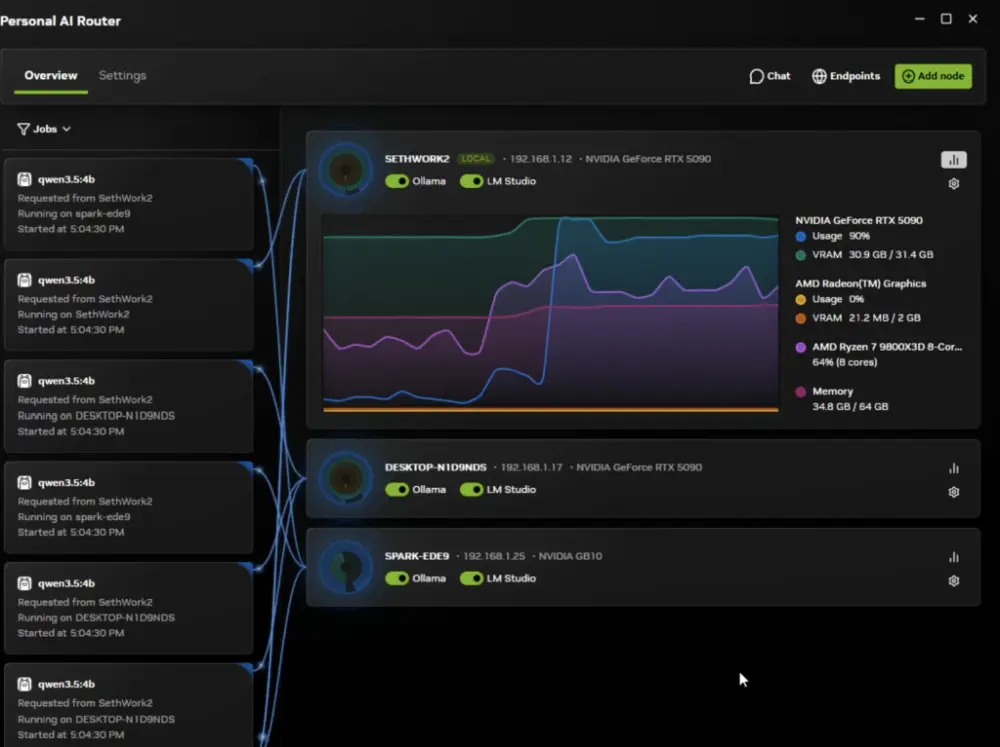
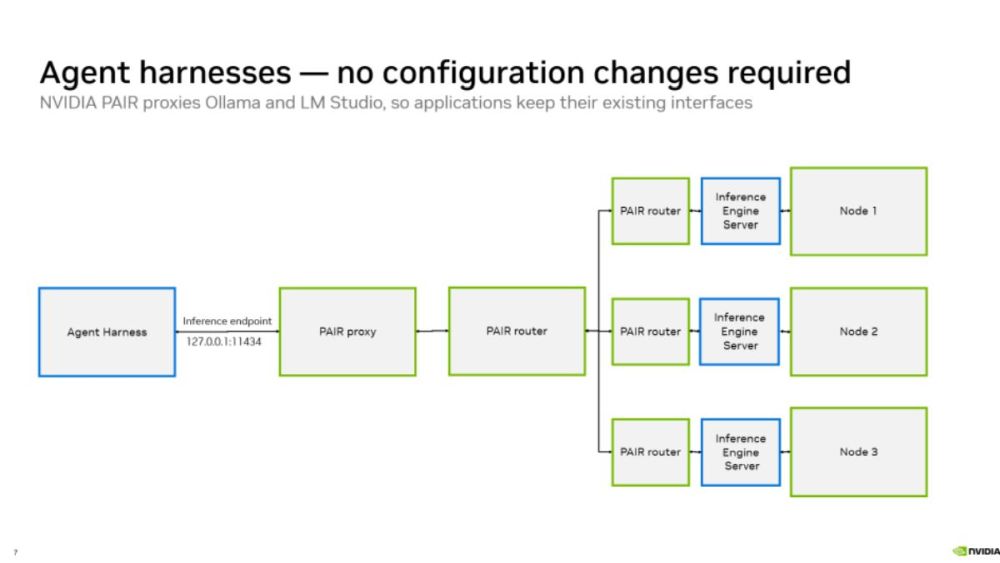
Nvidia used IFA 2026 in Berlin to lay out a sweeping local AI strategy, and the centerpiece is a free open-source tool that asks a quietly radical question: why let the computers already sitting in your home go to waste? Called the NVIDIA Personal AI Router, or PAIR, the software automatically discovers compatible PCs on a local network and routes AI inference requests to whichever machine has spare capacity. Nvidia’s argument is simple and hard to dismiss, since more than half of U.S. households own two or more PCs and much of that computing power sits idle through the day. PAIR works with the popular open-source inference applications Ollama and LM Studio, runs across Windows, macOS, and Linux, and accepts hardware spanning GeForce RTX 20-series GPUs and newer, RTX PRO workstation GPUs, DGX Spark, and Apple M4 or later chips. Crucially, it does not fuse multiple GPUs into one larger machine; instead it distributes independent inference requests across devices, easing the bottlenecks that appear when AI agents split complex tasks into parallel sub-jobs. In one company test, five sub-agents running simultaneously took about eighteen minutes on a single device but finished in under nine when spread across three machines using PAIR.
But raw pooled horsepower means little if the software remains too forbidding to install, and Nvidia spent equal effort attacking that second barrier. Three agent applications, namely Hermes Agent from Nous Research, Perplexity’s Portable Computer, and OpenClaw, are getting streamlined one-click installation on RTX and DGX systems, each built on llama.cpp with Nvidia’s inference optimizations already applied. On the performance side, the llama.cpp backend now delivers up to 1.9x higher throughput on a GeForce RTX 5090, while vLLM shows gains of up to 1.4x on two-DGX Spark clusters. The implication is that local AI is no longer a hobbyist curiosity confined to tinkerers willing to wrestle configuration files; it is being packaged as something closer to a consumer-grade product, with the setup friction stripped away and measurable speed gains layered on top.
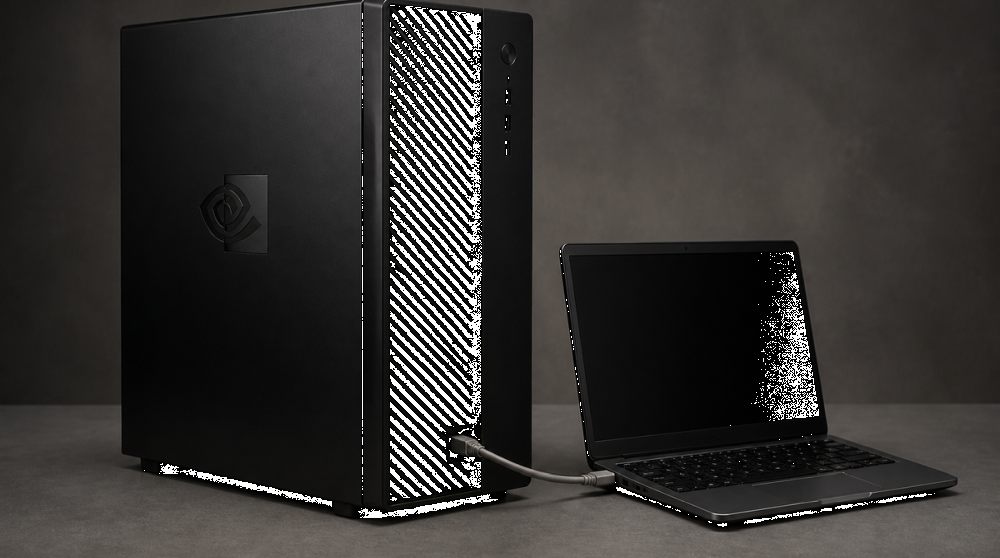
The hardware story converges on the same October timeline. Nvidia confirmed that its ARM-based RTX Spark Windows PCs will ship then under the product name N1X, a platform pairing a Blackwell-based RTX GPU with a 20-core Grace CPU, supporting up to 128GB of unified memory, and delivering up to one petaflop of AI compute. The OEM footprint is broad: Lenovo unveiled the Yoga Pro 9n and Yoga 9n 2-in-1, Acer showed a compact desktop design, and Asus, Dell, HP, and MSI are all preparing devices of their own. Just as telling is the software ecosystem lining up behind it. Electronic Arts, Embark, and Ubisoft have joined earlier supporters including Krafton, NetEase, Riot Games, and Xbox in committing game titles to the platform, a signal that N1X is being positioned not only as an AI workstation but as a machine serious enough to anchor a gaming and content pipeline.
Rounding out the picture is a wave of locally deployable models tuned for RTX hardware: Meta’s Muse Glimmer, DeepSeek v4 Flash, Qwen’s 3.8-Flash-Next, and Nvidia’s own Nemotron 3.5 Lightning. Taken together, the announcements sketch a coherent and ambitious thesis. Nvidia is not merely selling faster chips or a single product; it is trying to reframe the household computer as a node in a personal AI cluster, reduce the installation barrier to near zero, ship a unified ARM-based hardware platform with deep OEM and developer backing, and seed that platform with purpose-optimized models. Whether ordinary households actually want their living-room PCs quietly running inference jobs is an open question, but the infrastructure for that future is now being built, tested, and dated for October.

#Nvidia #IFA2026 #PAIR #LocalAI #RTXSpark #N1X #ArtificialIntelligence #Ollama #LMStudio #Blackwell #GraceCPU