
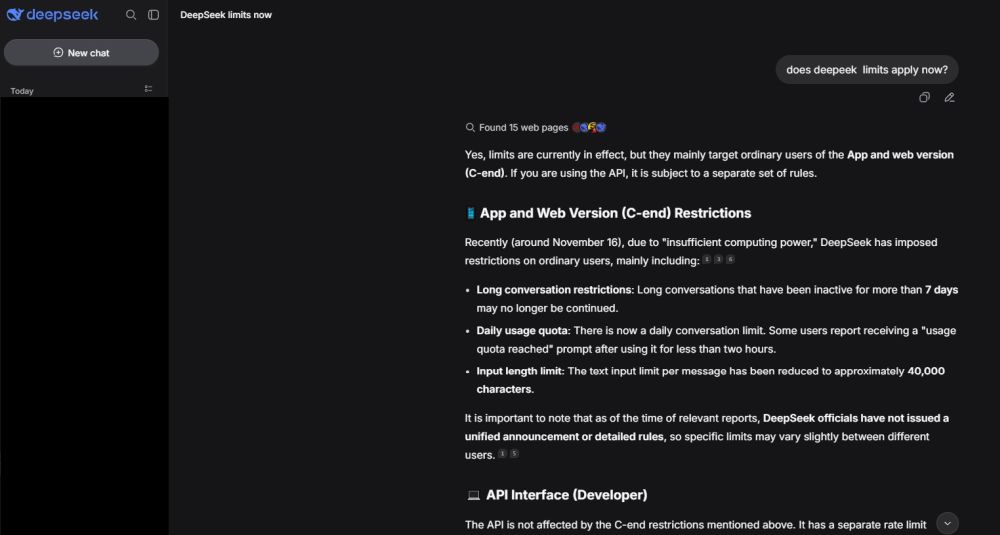
DeepSeek has begun placing new restrictions on its free chatbot, and users are only now piecing together what changed. People using the Chinese AI developer’s app and website report that the service has cited “insufficient computing capacity” when it ended older, inactive long conversations, reduced the amount of text a user can submit at once, and added a daily usage limit. The company has not issued a public explanation, leaving users to infer the rules from error messages and scattered reports. That silence has turned a routine capacity adjustment into a broader question about whether DeepSeek can sustain a free consumer product at scale.

The changes began surfacing on November 15, when users noticed that long conversations left inactive for more than seven days were no longer supported. Some reported a shorter cutoff of 72 hours. Others found that a single text submission was now capped at roughly 40,000 Chinese characters. When users reach the daily ceiling, the service tells them that their quota has been exhausted because of high server demand. DeepSeek has not disclosed the size of that quota, whether the restrictions are temporary, or when they might be lifted. Its public status page, meanwhile, showed all systems operating normally, suggesting the limits are a deliberate capacity-management measure rather than a response to an immediate failure.

The restrictions arrive after weeks of visible strain. DeepSeek’s status page has recorded repeated incidents since October involving its chat service and its V4 Pro and V4.1 Flash APIs. The website and API suffered partial outages on November 7, while an earlier disruption in mid-October affected the website, app, and API for nearly five hours. The company has also used other tools to manage demand: it paused API top-ups in early 2025, introduced lower off-peak API pricing in 2026, and quietly limited how often users could regenerate or edit responses in late May. The new chat limits fit that pattern, but they are more visible because they affect the free product that most consumers use.
The underlying issue may be bigger than a sudden surge in users. Analysts view the quotas as evidence of China’s persistent shortage of advanced computing capacity. United States export controls prevent Chinese companies from directly purchasing Nvidia’s most powerful chips, while reported plans to restrict chip exports to Malaysia, Indonesia, and Singapore, and to block Chinese remote access to data centers in those countries, could further tighten the supply. For now, the evidence remains largely anecdotal. But if DeepSeek confirms that the limits are permanent, it would signal that the constraint is not merely a short-term squeeze. It would be a lasting test of how far a leading Chinese AI company can grow when the hardware beneath it remains scarce.

#DeepSeek #AI #ComputingCapacity #ChinaAI #Chatbots #TechPolicy #Nvidia #AIAccess #ServiceLimits #ArtificialIntelligence