
Whispers in Silicon Valley have long hinted at Broadcom’s quiet ascent in the AI hardware race, but recent filings reveal a partnership fortress that’s now impossible to ignore. The chip giant has locked in a multi-year pact with Google to craft and deliver next-generation Tensor Processing Units, extending a collaboration that dates back over a decade. These custom beasts fuel Google’s AI empire, from training massive models to powering real-time inference. Yet what catches the eye is the scale: commitments stretch through 2031, signaling not just continuity but an acceleration that demands scrutiny. Is this merely business as usual, or the blueprint for AI dominance?
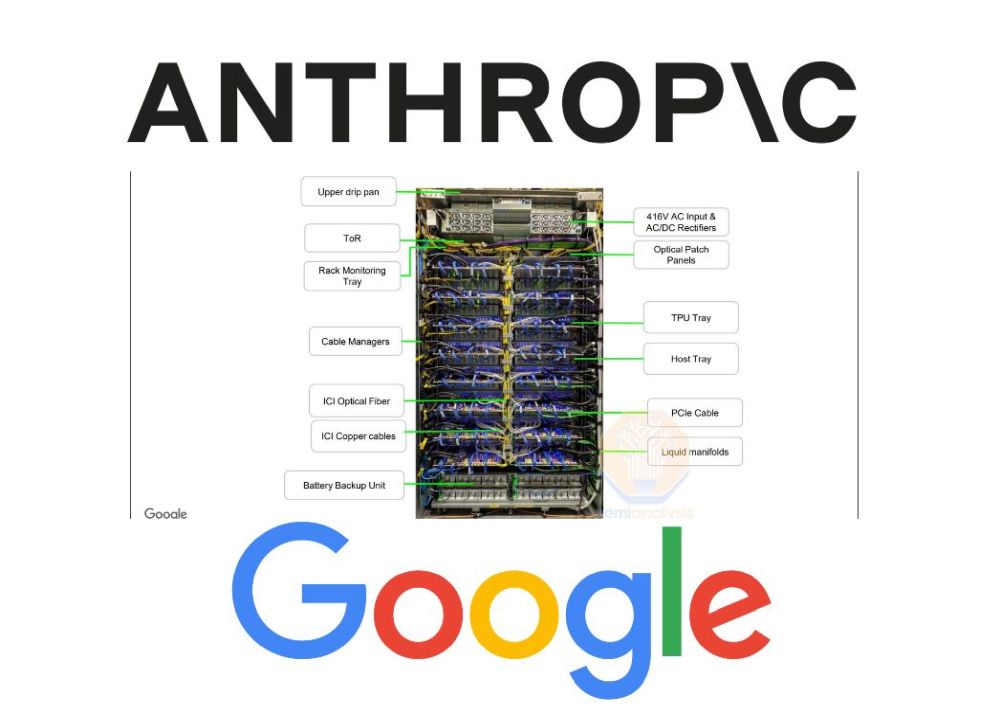
Dig deeper, and Anthropic emerges as the wildcard in this equation, pulling Google and Broadcom into a three-way alliance that’s reshaping compute access. Anthropic now taps into a staggering 3.5 gigawatts of TPU capacity starting in 2027, a volume that dwarfs previous deals and hinges on the startup’s commercial momentum. Investigative filings show discussions with unnamed partners to bankroll the infrastructure, raising questions about who foots the bill for this AI arms race. Broadcom’s fingerprints are everywhere, supplying not just processors but the networking sinews that bind these systems together. One can’t help but wonder: does this give Anthropic an edge over rivals, or tether it too tightly to Big Tech’s orbit?
Broadcom’s fingerprints extend far beyond this duo, painting a picture of calculated expansion. Fiscal reports boast AI revenue doubling to $8.4 billion in the latest quarter, with the CEO eyeing $100 billion in sales by 2027 from deployments at Google, Anthropic, Meta, and OpenAI. Every TPU iteration since the first has borne Broadcom’s design touch, evolving from niche experiments to gigawatt-scale juggernauts fabricated on cutting-edge nodes. Investors reacted swiftly, bidding up shares post-announcement, but skeptics probe the risks: supply chain chokepoints, dependency on a handful of hyperscalers, and the ever-looming specter of geopolitical tensions over advanced chips.

As these deals crystallize, Broadcom positions itself as the indispensable architect of AI’s physical foundation, but at what cost to innovation’s independence? The filings hint at a future where a few players control the silicon throttle, potentially dictating the pace of breakthroughs. Watch this space; the real story may unfold not in press releases, but in the power grids straining under unprecedented compute loads and the boardrooms plotting the next move.

#Broadcom #AIChips #Google #Anthropic #TPU #SiliconValley #TechDeals #AIInfrastructure