
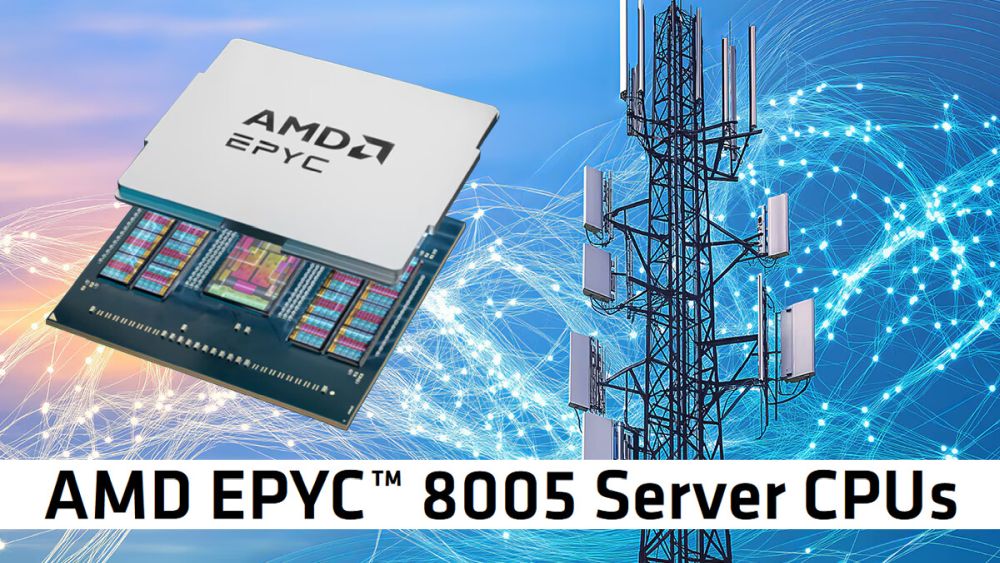
What if the real battleground for 5G dominance isn’t spectrum or antennas, but the raw economics of compute at the network edge? AMD’s freshly unveiled EPYC 8005 “Sorano” processors, packing up to 84 cores in a single socket, appear engineered to exploit exactly this vulnerability. Telecom operators racing to virtualize their radio access networks face a brutal reality: legacy hardware drains power and racks up costs in the dense, power-constrained environments of cell sites and edge data centers. AMD positions Sorano as the scalpel to carve out those inefficiencies, promising a generational jump from the 64-core ceiling of its Siena predecessor. But is this just marketing hype, or a calculated strike at Intel’s stronghold in telco infrastructure?
Delve deeper, and Sorano reveals telecom-specific tweaks that scream intentional design. Built on the Zen 5 architecture with beefed-up vector units, these chips accelerate Low-Density Parity Check decoding, the error-correction workhorse of 5G signals. This isn’t generic server silicon; it’s tuned to offload LDPC tasks, freeing cycles for more Layer 1 and Layer 2 functions on the same hardware. Single-socket configs, wide thermal tolerances, and compatibility with rugged NEBS standards make them ideal for outdoor deployments where every watt and cubic inch counts. Investigators might ask: how much did AMD sacrifice in raw clock speeds or memory bandwidth to prioritize these niche optimizations? Early whispers suggest trade-offs exist, but the payoff could reshape vRAN deployment math for operators squeezed by capex pressures.
The ecosystem play is equally telling, with heavyweights like Ericsson, Samsung Networks, and Wind River lining up endorsements that feel more like battle-tested validations than press-release fluff. Super Micro’s tailored edge servers round out a ready-to-deploy stack. This isn’t AMD flying solo; it’s a coalition signaling production maturity for Open RAN and edge AI ambitions. Yet skeptics probe the timing: with Mobile World Congress looming, is this teaser calibrated to steal thunder from Intel’s Xeon 6 Granite Rapids-D chips, which cap at 80 cores? AMD claims a core-count edge, but real-world benchmarks on bandwidth and power draw will decide if Sorano truly disrupts the status quo.
As operators grapple with the vRAN economics riddle, AMD’s Sorano processors emerge as a provocative solution, blending raw core muscle with telco-tailored smarts. Will they tip the scales toward software-defined networks at scale, or prove another incremental upgrade in a fiercely contested arena? The proof lies in upcoming benchmarks and deployment wins, but one thing is clear: AMD is betting big that edge compute efficiency holds the key to telecom’s next wave.

#AMD #EPYC #Sorano #vRAN #5G #EdgeComputing #Telecom #Zen5